
What we would never put in a kids’ app
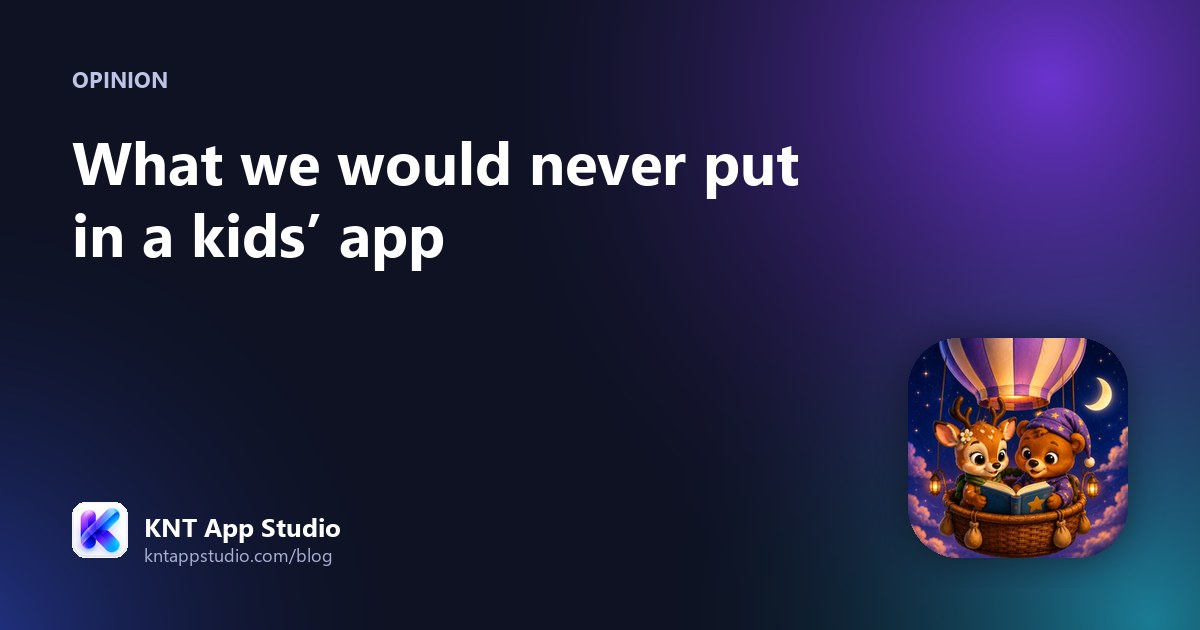
Dreamify is used by parents, at a child's bedside. That sentence rules out a surprising number of features that would be normal elsewhere. We wrote them down early so that no good quarter would tempt us.
No ads
Nothing a child looks at in the app will ever contain an advertisement. Not a banner, not a "sponsored story", not a rewarded video for an extra tale. Advertising to children is a line, and a bedtime app that crossed it would deserve to be deleted.
No links out
No buttons that open a browser, no app-store links to other products, no "share to" sheets in the child-facing flow. The app is a closed room with a story in it. Everything a parent might want, from settings to support to our website, lives behind the parent's area.
No social features, no chat
No sharing stories with strangers, no community, no comments, no chat with a character. Each of those is a moderation problem and a safety problem, and none of them has anything to do with falling asleep.
No photos of children
The hero in the illustration looks like a storybook character with the child's name. It could look like the child, and parents sometimes ask. We would have to hold photos of children to do it, and we are not willing to.
No data from children
Profiles are made and controlled by parents. The app does not ask children for anything, does not record them, and treats the few details it holds as the parent's to edit and delete.
No paywall designed to trap
A clear price, a visible close button, a trial that says when it ends. A parent at 8 p.m. should never feel cornered by a children's app.
Why a list of refusals is a strategy
Each of these would earn something. Together, refusing them is why a parent can hand the phone to a child and leave the room, and that trust is the only reason the app exists. A short list of things we will not do is the clearest statement of what we are for.
Written by Osman Kantarcıoğlu, founder of KNT App Studio. He designs and ships the studio's iOS apps (Dreamify, Viola and GERG) and runs Apple Search Ads and ASO for the studio and the teams it works with. Posts describe what we did and what it cost; when a number is an estimate, the text says so.